monoidal#
The free (pre)monoidal category, i.e. planar diagrams.
Summary#
A 0-cell, drawn using its matplotlib-compatible |
|
A generating 1-cell with a colour on either side. |
|
The free monoid on a |
|
A type is a composable path of objects with |
|
|
|
A dimension is a tuple of positive integers with product |
|
A layer is a tensor product of boxes and plumbing, i.e. non-empty types. |
|
A diagram is a tuple of composable layers |
|
A box is a diagram with a |
|
A sum is a tuple of diagrams |
|
A bubble is a box with diagrams |
|
A monoidal functor is a functor that preserves the tensor product. |
|
An |
Axioms#
We can check the axioms for Ty being a monoid.
>>> x, y, z, unit = Ty('x'), Ty('y'), Ty('z'), Ty()
>>> assert x @ unit == x == unit @ x
>>> assert (x @ y) @ z == x @ y @ z == x @ (y @ z)
We can check the axioms for dagger monoidal categories, up to interchanger.
>>> x, y, z, w = Ty('x'), Ty('y'), Ty('z'), Ty('w')
>>> f0, f1 = Box('f0', x, y), Box('f1', z, w)
>>> d = Id(x) @ f1 >> f0 @ Id(w)
>>> assert d == (f0 @ f1).interchange(0, 1)
>>> assert f0 @ f1 == d.interchange(0, 1)
>>> assert (f0 @ f1)[::-1][::-1] == f0 @ f1
>>> assert (f0 @ f1)[::-1].interchange(0, 1) == f0[::-1] @ f1[::-1]
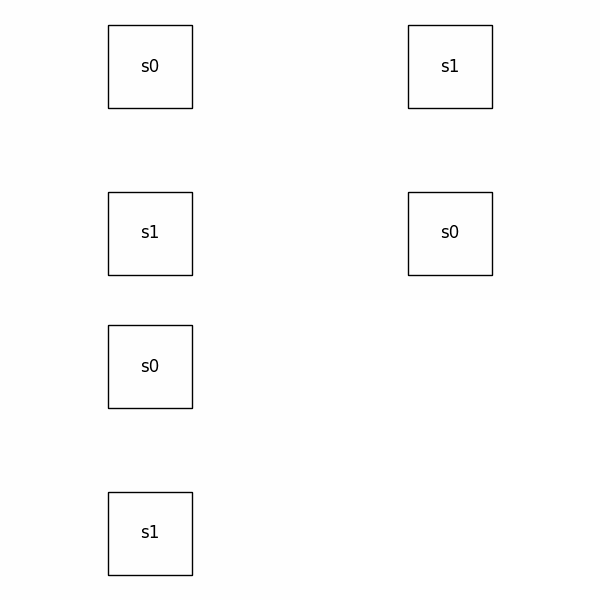
We can check the Eckmann-Hilton argument, up to interchanger.
>>> s0, s1 = Box('s0', Ty(), Ty()), Box('s1', Ty(), Ty())
>>> assert s0 @ s1 == s0 >> s1 == (s1 @ s0).interchange(0, 1)
>>> assert s1 @ s0 == s1 >> s0 == (s0 @ s1).interchange(0, 1)